
Cable Insulation Wall Thickness Concentricity Measurement
Introduction
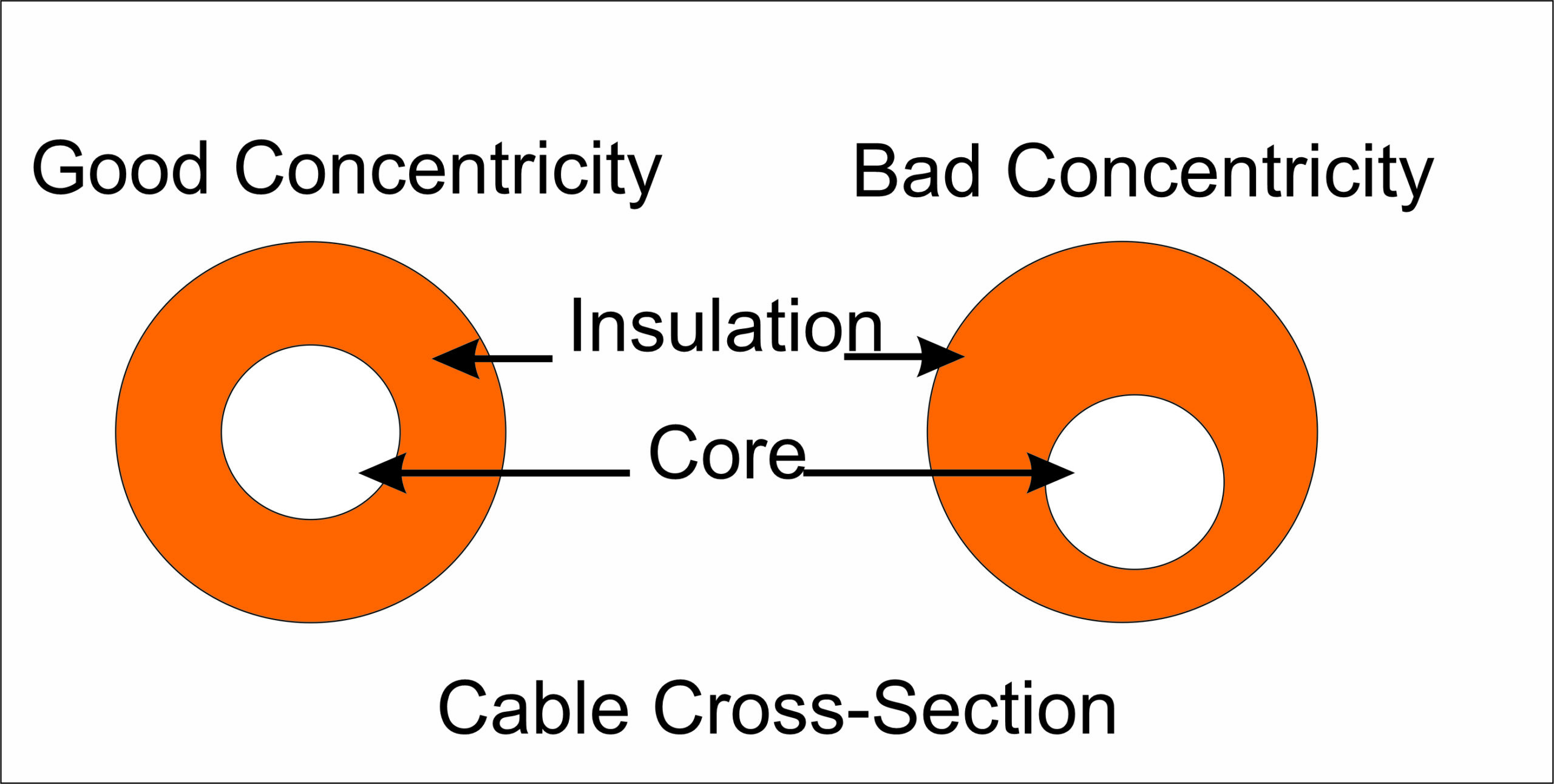
Concentricity Measurement of Cable Wall Thickness is an important parameter in cable insulation thickness measurement, as it gives an overall idea about the symmetric distribution of the cable insulation around the conductor. Ideally, it should be 100%, but in real conditions this value ranges between 70–90%. The higher the value, the better it is. Concentricity, combined with minimum insulation thickness values, determines whether the cable is safe to use and complies with applicable standards.
Concentricity is a relative measurement and can be defined as having the same centre. For example we have two circles (zero thickness) of same or different diameters and if they have same centre, they are said to be concentric with 100% concentricity. However if these circles are moved relative to each other, their centres too will move relatively and they are no longer concentric. The closeness of their centres determines the percentage of their concentricity.
Cable Concentricity
In practical applications, for example in cable insulation wall, the insulation can be thought of made up of infinite circles of gradually increasing diameters. The centres of all these circles will not be at the same point but will be placed close to each other. This closeness is related to the concentricity of the cable insulation.
Calculating Concentricity
The challenge in calculating concentricity comes from the deficiencies in accurately determining the minimum and maximum wall thicknesses during wire insulation thickness measurement using an advanced wire insulation thickness measurement system, which form the basis of calculating concentricity. Traditionally, these measurements were being done with the help of Profile Projector which is dependent on the operator skills to visually probe and determine maximum and minimum thickness and therefore prone to errors. However with the coming of video edge detection and powerful algorithms, the human dependence on accurately calculating minimum and maximum thickness has ended.
The following formulas are used for calculating the concentricity of cable insulation wall thickness
1. Average Concentricity
[(Max Thickness – Min Thickness) / (Max Thickness + Min Thickness) * 100]
2. Average Concentricity
(Min Thickness/ Max Thickness) * 100
3. Maximum Concentricity
1-(((Average Thickness – Min Thickness)/(Average Thickness + Min Thickness)) * 100)
4. Minimum Concentricity
((Max Thickness- Average Thickness )/(Average Thickness + Max Thickness)) * 100)
The most commonly used formula for Concentricity Measurement is Formula 1 and Formula 2. Few of the customers opt for Formula 3 and 4.
Conclusion
Cable insulation wall thickness concentricity is an important parameter that, along with cable insulation thickness measurement, is vital for determining the safety of an electrical cable. This necessitates high-accuracy measurement. Cable Genie, an image-based measurement system or digital image analyser, probes 10,000 points on the cable cross-section to determine maximum and minimum thickness, thus providing accurate cable insulation concentricity measurement.
Frequently Asked Questions
Q 1: What is cable insulation thickness measurement?
Cable insulation thickness measurement is the process of determining the thickness of insulation surrounding a conductor to ensure electrical safety, performance, and compliance with industry standards.
Q 2: Why is concentricity important in wire insulation thickness measurement?
Concentricity ensures that insulation is evenly distributed around the conductor. Poor concentricity can lead to weak insulation zones, increasing the risk of electrical failure.
Q 3: How is cable insulation concentricity measured accurately?
Modern image-based wire insulation thickness measurement systems and digital image analyzers measure thousands of points on a cable cross-section to calculate accurate minimum and maximum insulation thickness values.
Q 4: Can manual methods affect wire insulation thickness measurement accuracy?
Yes. Manual methods like profile projectors depend heavily on operator skill and can introduce errors, especially while identifying minimum and maximum thickness points.
Q 5: What standards require cable insulation thickness measurement?
Most international cable standards specify minimum insulation thickness and concentricity limits to ensure cable safety, durability, and electrical performance.