
Camera Based Profile Projector: Working, Benefits, & Applications
Camera based profile projectors represent a major advancement in quality control technology within modern manufacturing. These systems integrate high-resolution cameras and advanced software to achieve precise inspection of complex components through non contact methods.
The traditional profile projectors would rely on shadow projection on a big screen, whereas the one with cameras records the digital images and can provide real time inspection on a computer display. Such methods provide a clear view of dimensions, shapes, angles, and surface features while also identifying minor deviations from specifications.
Sipcon Instrument is a leading camera based profile projector manufactures in India. With its automated edge detection and real-time measurement improve efficiency and reduce errors in production environments.
What Is a Camera Based Profile Projector
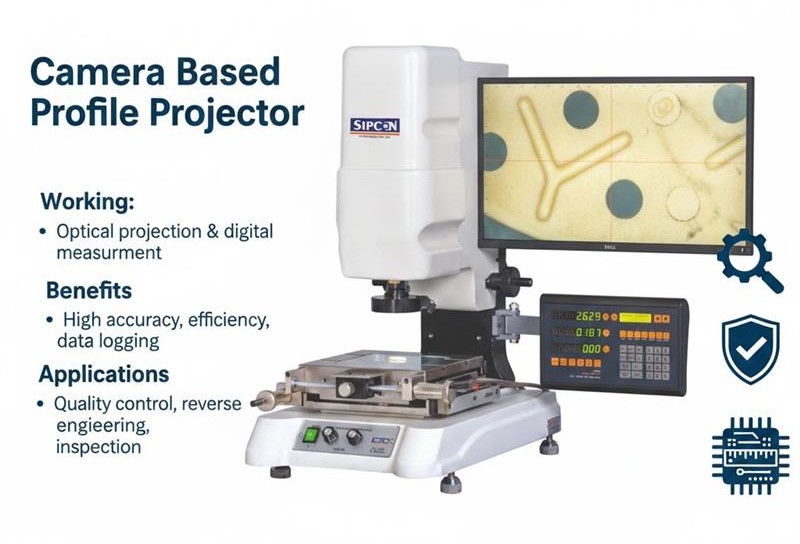
A camera based profile projector operates as a non-contact optical measurement instrument that magnifies and examines small workpieces with exceptional detail. Rather than projecting shadows onto a glass screen as in conventional designs, this technology employs a high-resolution camera to produce detailed images. The software processes these images to quantify curves, lines, and features accurately.
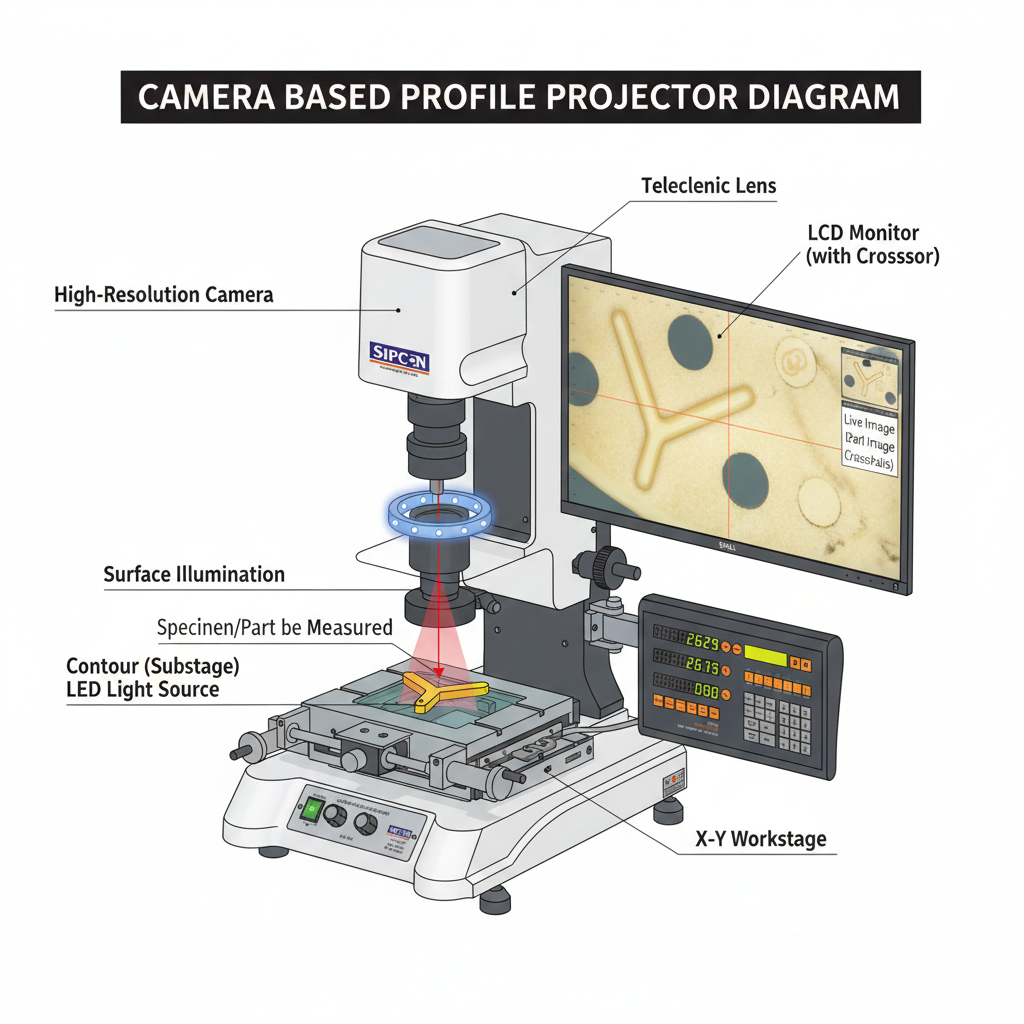
Positioning a gear or circuit board on a precision platform activates the system. Contour and surface illumination create high contrast to define edges clearly. The camera records the image, and the software calculates lengths, radii, threads, and other parameters rapidly. This transition from analog to digital eliminates interpretation issues associated with shadow projections. Repeatability improves substantially, as consistent algorithms eliminate variability in high-volume production.
How Camera Based Profile Projectors Work
The measurement process begins with securing the part on the XY work stage, equipped with micrometer controlled movement. Focus adjustment occurs through a programmable controller, while contour and surface lights optimize contrast. The camera then acquires high-resolution images capable of resolving features finer than a human hair.
Edges are automatically followed and distances, angles, and tolerances are computed using algorithms. Measurement of linear dimensions, radii and geometrical elements is performed with precision on screen tools. This is because measurement results are shown immediately in color coded format to show whether it is within the set limits. The data can be stored with timestamps to allow traceability when integrated with digital readouts or PC based systems.
The main components consist of workstages (with a measurement accuracy of 0.0005mm), a halogen or LED illumination system (adjustable at 24V 150W), and cooling mechanisms to ensure long-term operation. Optional Components such as Rotary Tables provide full 360-degree access during the rotation process. Edge Detectors measure the position of elements for alignment without the need for manual adjustment, thus providing a more streamlined workflow.
Key Advantages Over Traditional Models
- Compared to older systems, camera based profile projectors have much better speed of operation and accuracy of measurement. Digital image processing takes seconds rather than the previous method of manually tracing drawn profiles on projection screens.
- The use of software-driven automation eliminates parallax errors due to the use of optical viewing.
- The non contact nature preserves delicate materials such as soft plastics, thin films, and microelectronics.
- Magnification up to 100x reveals microscopic details unattainable through manual inspection.
- Data export functions in standard formats support statistical process control and regulatory compliance.
- Inspection times decrease by approximately 70 percent due to automated feature recognition.
- Compatibility with CAD files allows overlay comparisons between physical parts and digital designs, accelerating validation and reducing scrap rates.
Applications of Camera-Based Profile Projector Across
In automotive manufacturing, camera-based profile projectors verify gears, shafts, pistons, and injectors to maintain critical tolerances essential for performance. The following are the core applications of these projectors:
- Aerospace applications demand similar precision for turbine blades, fasteners, and structural components where deviations impact safety.
- Electronics production utilizes the systems to confirm PCB traces, connector pins, and semiconductor features for reliable signal integrity.
- Tool and die fabrication inspects punches, molds, and fixtures to ensure consistent downstream part quality.
- Medical device manufacturing examines stents, catheters, and implants in accordance with regulatory standards.
- The camera profile projector has extensive applications in rubber and plastic processing by creating a contact free measurement to avoid surface distortion on extrusions, gaskets, and seals.
Technical Specifications of Camera-based Profile Projector
Camera-based profile projector manufacturers offer models that hold a variety of different capacities, ranging from 100mm x 100mm to 500mm x 400mm in the working area. They also offer resolution capabilities with a range of 0.001mm to 0.0005mm, as well as focus travel extending 100mm and making it possible to accommodate parts with varying heights.
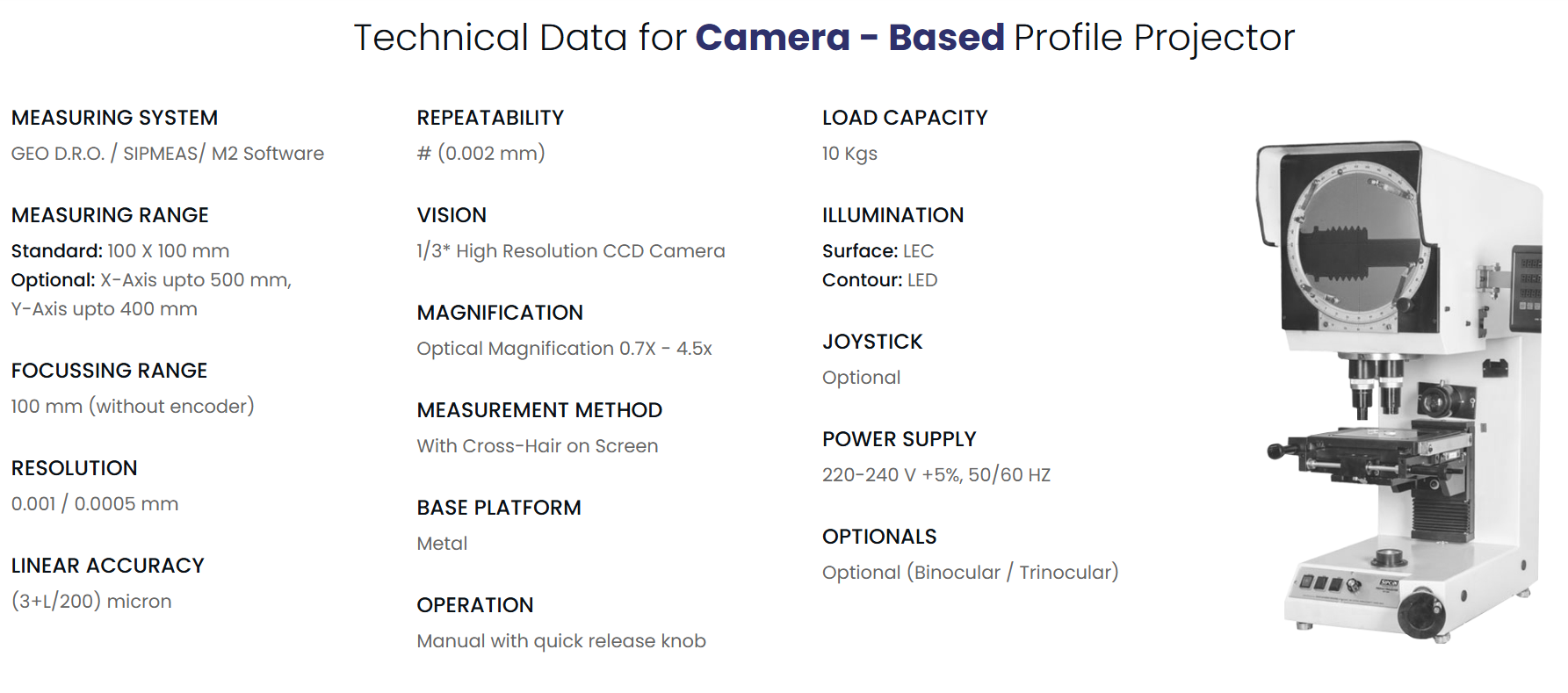
The lighting systems have high-intensity condensers to define edges. Geo DRO interfaces or SIPMEAS software offer thread profile, spline, and geometric dimension tolerance tools. The equipment is customized to particular geometries by the use of accessories, including V blocks, centers, and footswitches.
Construction incorporates granite bases and vibration isolation for environmental stability. Factory calibration traceable to national standards ensures long term performance. User interfaces facilitate rapid operator training and minimal downtime.
Maintenance and Best Practices
Images can be protected by cleaning the lenses and sensors with proper materials on a regular basis. Accuracy is checked using standard gauge blocks on a biannual basis. New functionalities and compatibility additions are brought up by software updates.
Each day, stage realignment controls and covers are used to prevent dust or debris contamination. Throughput is optimized by training the operators on advanced features. Full measurement recording including image capture, assists in audit requirements and process enhancement. These practices guarantee good performance in long term.
Camera-Based Profile Projector Manufacturers: Why Choose Sipcon Instrument
Sipcon Instrument is a leading camera-based profile projector manufacturer in Ambala, India. We specialize in benchtop and floor-standing models with professional performance at competitive costs. Sipcon’s extensive manufacturing experience aligns products with international quality standards.
Detailed product information and customization options are available through sipconinstrument.com. Investment in Sipcon Instrument provides scalable solutions that enhance operational precision and efficiency.
Conclusion
The use of camera based profile projectors essentially transforms quality assurance in the manufacturing process by providing unprecedented speed and reliability. These systems reduce defects, improve production efficiency, and meet the highest quality standards across the automotive, aerospace, electronics, and medical industries. As industries continue to shift towards automation and camera miniaturization, staying ahead requires more than just precision but also the right technology partner.
At Sipcon Instrument, we design and deliver advanced camera based profile projectors built for real-world manufacturing challenges and maintain consistent excellence in every measurement. Whether you are scaling production or upgrading your quality control process, our systems are engineered to grow with your requirements. Explore our range of profile projectors and contact us today to bring greater accuracy and efficiency to your products.