

SI Units of Measurement: Full Form, List and Uses
SI units of measurement form the backbone of how engineers, technicians, and manufacturers communicate numbers with clarity.
In this blog post, you will learn the full form of SI units, understand the different types such as base, supplementary, and derived units, and see how they are used in real engineering and manufacturing situations.
So, a cable manufacturer in India measures insulation thickness as 2.5. The test report is sent to a customer in Germany.
The customer reads the value: 2.5 what?
Millimetres? Inches? Centimetres?
The number alone tells you nothing. A measurement begins to mean something only when its unit is clearly defined.
What is the International System of Units (SI)?
This is where the International System of Units (SI) comes in. SI units provide a uniform measuring interface used across engineering, science, and manufacturing.
Before SI became the global standard, different systems of units were used in different regions and industries. Some of the most commonly used systems include:
- CGS System (Centimetre–Gram–Second) – used in early scientific work
- MKS System (Metre–Kilogram–Second) – the foundation on which SI is built
- FPS System (Foot–Pound–Second) – commonly used in the United States
- Imperial System – traditional British system still used in some applications
- SI System (International System of Units) – the official system used in India and most countries today
When a technician writes 2.5 mm, everyone understands exactly what it means and how much it measures, whether you measure it on Mars or on Earth.
Here is a machine shop scenario:
A shaft diameter is specified as 20 mm.
The tolerance is ±0.02 mm.
If one engineer measures 19.98 mm and another measures 20.01 mm, both know the shaft is good to go. There is a mental and mechanical agreement about the numbers because everyone is using the same unit system.
The same applies to electrical measurements.
If a power cable carries 230 volts and draws 5 amperes, the electrical power becomes 1150 watts. These values are not random. They come from a standardized system of units that engineers use around the world every day.
The SI system was formally adopted in 1960 by the General Conference on Weights and Measures (CGPM) and has since become the global standard for measurement.
Today, SI units appear everywhere:
- Engineering drawings
- Laboratory reports
- Quality inspection records
- Manufacturing specifications
Without this shared system, technical communication would quickly fall apart.
Let’s now look at the different categories of SI units. We will also see how they are used in practical engineering situations.
SI Base Units: Definition, List and Examples
Every measurement system needs a foundation. In the SI system, that foundation is made up of seven base units. These units represent the most fundamental physical quantities. Everything else in measurement originates from them.
You can think of them as the basic ingredients of engineering calculations.
Examples of SI base units in engineering
We begin with length: if a cable has a length of 100 metres (m) and it is cut into two equal parts, each piece becomes 50 m long. The metre is the standard SI unit used to describe distance, size, and dimensions in engineering drawings.
Now mass: a metal component may weigh 5 kilograms (kg). If two identical parts are placed together on a scale, the total mass becomes 10 kg. The kilogram is the base unit used to measure mass in manufacturing, material testing, and logistics.
Time is another essential quantity. If a machine completes one production cycle in 10 seconds (s), then in one minute it can complete 6 cycles. The second allows engineers to measure motion, speed, and process timing.
Electrical systems rely on another base unit: electric current.
If a motor draws 3 amperes (A) of current at a certain load, increasing the load may raise the current to 5 A. The ampere is the SI unit used to describe the flow of electric charge.
Temperature also plays a critical role in measurement.
Suppose a laboratory maintains a temperature of 293 kelvin (K), which is roughly 20°C. Keeping measurements close to this reference temperature helps maintain dimensional stability in precision inspection.
Another base quantity is the amount of substance, measured in moles (mol). For example, a chemical process may involve 2 mol of oxygen reacting with another compound during a laboratory experiment.
Finally, there is luminous intensity, measured in candela (cd). If a light source emits 10 cd, doubling the source intensity would produce 20 cd.
List of SI base units
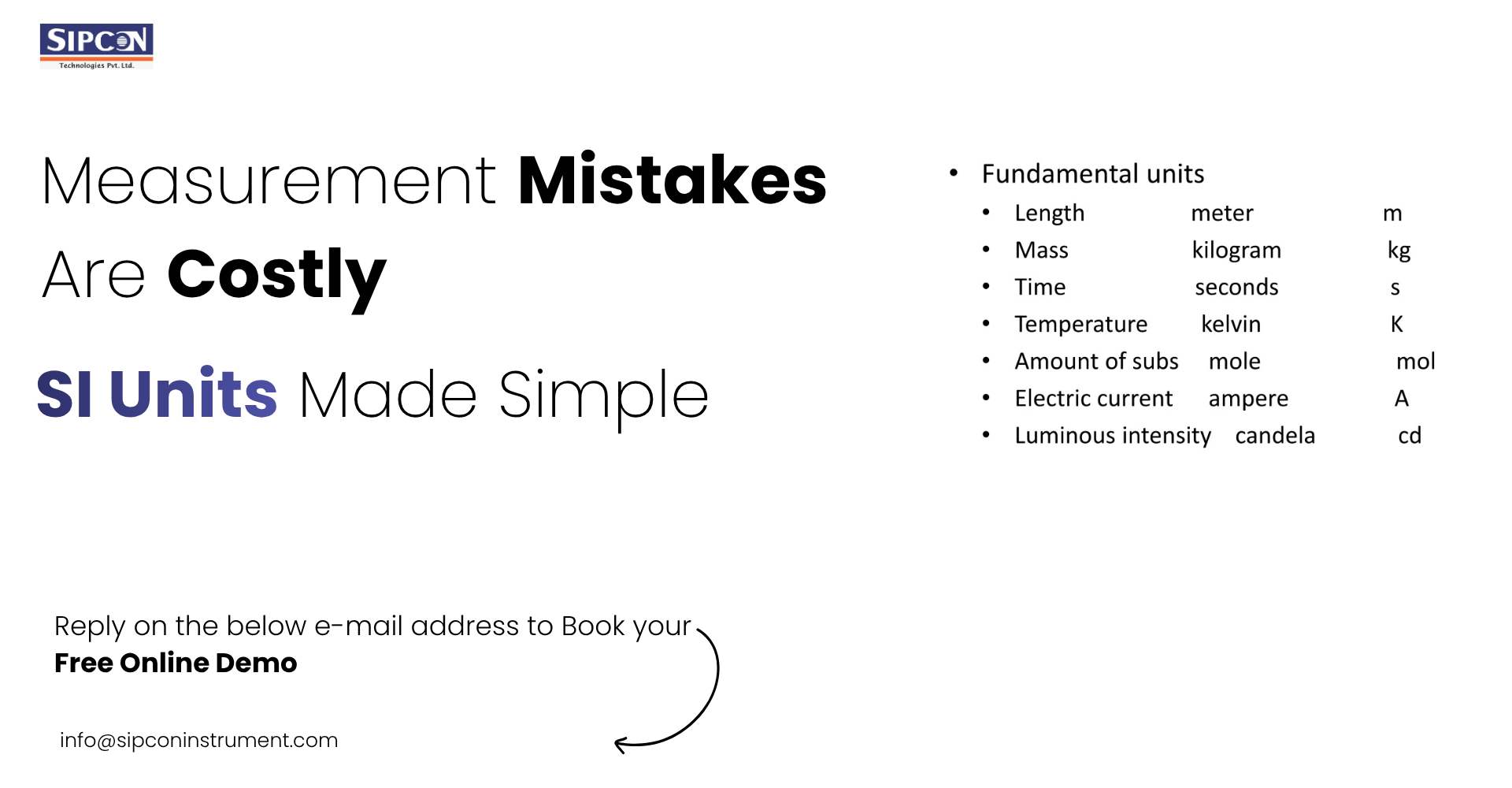
These seven base units form the backbone of the SI system:
| Physical Quantity | Unit Name | Symbol |
| Length | Meter | m |
| Mass | Kilogram | kg |
| Time | Second | s |
| Electric Current | Ampere | A |
| Thermodynamic Temperature | Kelvin | K |
| Amount of Substance | Mole | mol |
| Luminous Intensity | Candela | cd |
Once these basic quantities are defined, engineers can combine them to describe more complex physical phenomena. Read on.
SI supplementary units: radian and steradian Explained
Not every measurement can be represented by length, mass, or time. Some are angular. For these situations, the SI system uses supplementary units.
The most common one is the radian (rad), which measures plane angles.
A full circle equals 2π radians, or about 6.283 rad. If a machine shaft rotates π rad, it has completed half a turn. When engineers calculate angular speed, they often use radians per second. For instance, a motor rotating at 4 rad/s will rotate twice as fast as one running at 2 rad/s.
The second supplementary unit is the steradian (sr). It measures solid angles, which describe how energy spreads in three-dimensional space.
A sphere contains 4π steradians, which is about 12.57 sr, meaning light spreading in all directions covers this total angular space. Now imagine a lamp emitting 100 lumens of light. If this light is concentrated within 1 steradian, it appears brighter because it is focused in a smaller region.
But if the same 100 lumens spreads over 2 steradians, the light covers a larger area, so the brightness in each direction reduces. In simple terms, the total light remains the same, but spreading it over a wider angle makes it appear dimmer.
Uses of supplementary units in engineering
These units may appear less frequently than metres or kilograms, but they are critical in specific applications:
- Radian (rad) – used in rotational motion, motors, and mechanical systems
- Steradian (sr) – used in lighting, optics, and radiation analysis
In the end, SI units work as one system. Whether measuring 20 mm shaft diameter, 5 A current, or 3 rad/s rotation, the meaning stays the same everywhere. That consistency is what makes engineering communication reliable.

Conclusion:
The SI system provides a universal language for measurement, ensuring accuracy across all scientific and industrial sectors. By following these global standards, Sipcon Instrument maintains the high precision necessary for reliable quality control. Ultimately, these units are the foundation for consistent manufacturing and global technical collaboration.