
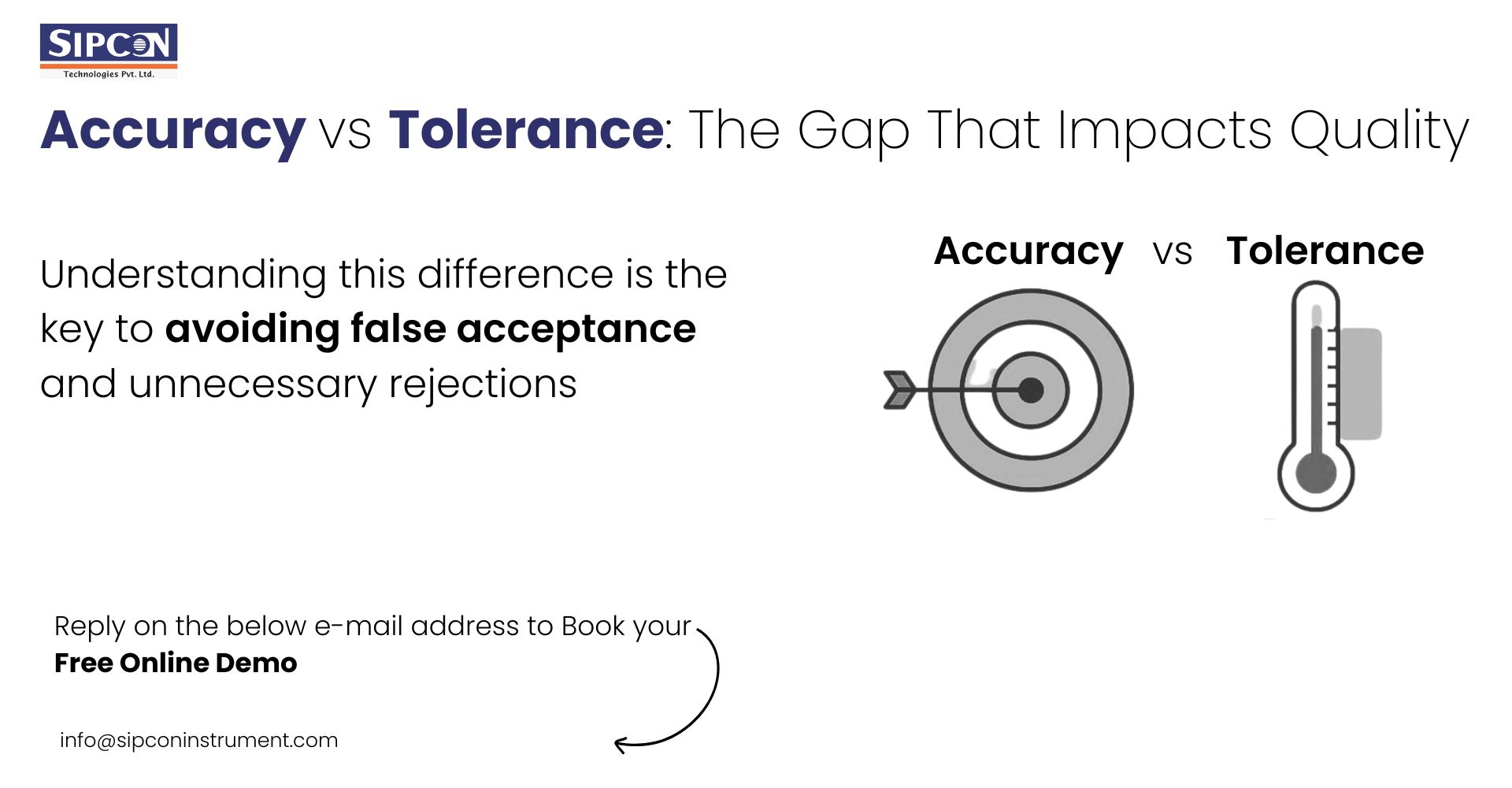
Tolerance vs. Measurement Accuracy: Key Difference in Calibration
Most people mix up two things – the meaning of tolerance and the importance of tolerance in measurement. They sound similar. They are not. One defines the allowed limits. The other depends on how well you measure.
Now add calibration into the picture. Instruments drift. Temperature changes. Operators vary. Suddenly, that 10.02 mm reading is not as reliable as it looks.
This is where the real question starts.
Is your part within tolerance?
Or is your measurement giving you misleading comfort?
On many occasions, your product is not rejected because it is bad. It happens because the measurement system is not accurate enough. And sometimes, the opposite is worse – bad parts pass because the system hides the error.
In this blog, we will break this down clearly. First, we will understand what tolerance actually means. Then we will see why measurement accuracy changes everything. And finally, how both together affect quality and decision making in real-world manufacturing.
Meaning of Tolerance
Tolerance is simple in definition, but often misunderstood in practice.
It is the allowed range in a dimension, which defines the limits within which a part is considered acceptable, even if it is not exactly at the nominal size.
If a shaft is specified as 10 mm ± 0.05 mm, it means:
Upper limit: 10.05 mm
Lower limit: 9.95 mm
Anything within this range is acceptable. Anything outside is not.
That sounds straightforward. But here is where things start to go wrong.
Tolerance does not tell you:
- How the part was measured
- How accurate the instrument is
- Whether the reading can be trusted
It only defines the upper and lower limit of acceptance.
In real manufacturing, this distinction matters more than you think.
Take a simple example. A cable insulation thickness is measured at 1.98 mm, with a minimum requirement of 2.00 mm. On paper, it fails. But what if the measurement system has an error of ±0.03 mm? The actual thickness could be above 2.00 mm, yet the part gets rejected.
The opposite can also happen. A part may appear within tolerance, but due to poor measurement accuracy, it slips through even though it is actually out of spec.
You need to keep in mind that
- Tolerance defines the rule.
- Measurement decides whether you are following it or not.
This is exactly why understanding tolerance alone is never enough.
Importance of Tolerance in Measurement
Tolerance starts as a design decision, but its real value shows up during measurement.
On paper, tolerance defines what is acceptable. On the shop floor, measurement decides what actually gets accepted or rejected. That is where things become tricky, because measurement is never perfect.
Every measurement system has some level of error. It could come from:
- Instrument accuracy limits
- Calibration status
- Temperature variation
- Operator handling
Now connect this with tolerance.
If your tolerance is ±0.05 mm and your measurement system error is ±0.03 mm, you are operating within a very tight window. A small shift in measurement can change the decision completely.
This is why in metrology, we follow a basic principle:
Measurement system error should be significantly smaller than the tolerance
In many industries, a common guideline is:
Measurement uncertainty ≤ 25–30% of the tolerance band, otherwise, decisions become unreliable.
Let’s take a simple example from machining: A component has a tolerance of 20.00 ± 0.10 mm. You measure it as 19.92 mm.
It is within tolerance. But if your measurement system has an uncertainty of ±0.08 mm, the actual value could be 19.84 mm, which is outside the lower limit.
Now what do you do?
Accept it? Reject it? Re-measure it?
This confusion is not because of tolerance. It is because the measurement system is not strong enough to support that tolerance.
This is where calibration becomes critical. Calibration ensures that your instruments are aligned to known standards, reducing uncertainty and improving confidence in the results.
So, the importance of tolerance in measurement is not just about defining limits. It is about ensuring that your measurement system is capable of making correct decisions within those limits.
Tolerance vs. Measurement Accuracy
| Feature | Tolerance | Measurement Accuracy |
| Definition | The acceptable range of variation for a product’s dimension. | How closely a measurement aligns with the true value. |
| Origin | Determined by engineering specifications. | Determined by the capability of the measuring instrument. |
| Focus | The product itself. | The instrument being used. |
| Application | Ensures the product functions and fits. | Validates that the instrument provides correct data. |
Tolerance and Quality
Quality is often judged by one question – does the part meet the specification? That specification is defined by tolerance.
If a part stays within tolerance, it is accepted. If it goes outside, it becomes a defect. But real quality is not just about staying inside limits. It is about how consistently you stay inside them.
- Parts well within tolerance means stable process
- Parts near limits means higher risk
- Parts crossing limits means poor quality
Now bring measurement into this discussion. If your measurement system is not accurate good parts may get rejected and bad parts may get accepted
A common example comes from precision machining. A component may be within tolerance, but due to poor calibration, it gets rejected. Or worse, an out-of-spec part passes and creates issues during assembly.
Quality is not controlled by production alone. It depends equally on how accurately you measure.
Tolerance defines the limits of quality, while measurement accuracy ensures those limits are judged correctly.
Tolerance and decision-making in Measurement
At the end of the day, every measurement leads to a decision.
Accept the part. Reject it. Rework it. Hold it for review.
This decision is never based on tolerance alone, but on how tolerance and measurement accuracy work together.
Tolerance gives you the limits. Measurement tells you where the part stands. But if the measurement itself is uncertain, the decision becomes risky.
- A part close to the limit may be accepted when it should not be
- A good part may be rejected due to measurement error
- Repeated measurements may give different results
This is where most audit issues and production losses begin.
In calibration and metrology, the goal is simple – reduce uncertainty so that you can depend on your decisions. That is why calibrated, repeatable, and operator-independent measurement systems are critical, especially when tolerances are tight.
In real manufacturing, the problem is rarely the tolerance; it is the confidence in the measurement.
This is where modern systems are changing the way quality control works. Camera-based profile projectors, for instance, remove operator variation, speed up inspection, and provide consistent, repeatable measurements across batches.
At Sipcon Technologies Pvt. Ltd., we build camera-based profile projectors designed for real manufacturing conditions, helping you achieve faster, more reliable decisions in quality control.
Explore our solutions and connect with us to improve accuracy, reduce defects, and bring consistency to your measurement process.