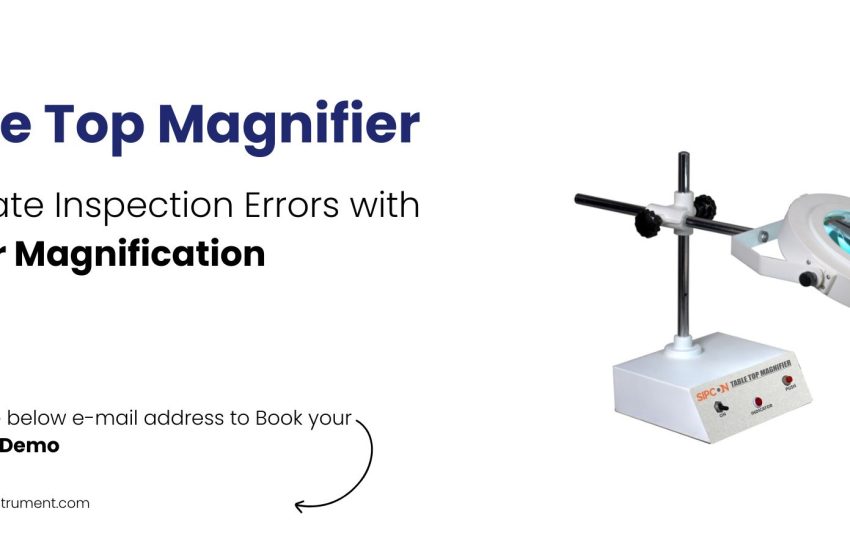

Table Top Magnifiers for Saudi Manufacturing & Electronics QC: A Buyer’s Guide
Manufacturers must rely on actual inspection solutions that enable the quality group to efficiently detect defects in an insightful manner as Saudi Arabia continues to grow its advanced manufacturing, electronics assembly, and precision engineering sectors. To avoid taking all detailed inspections to a high-end measuring system, a table top magnifier offers a simple, available method to examine electronic assemblies, small components, machined parts, or other detailed work.
For Saudi manufacturers selecting an inspection magnifier, magnification alone is not the only consideration. Mounting method, working space, inspection requirements and the size of features being examined all matter. This buyer’s guide compares three options, TTM (I), TTM (II) and TTM (III), and explains how they can fit into a modern quality-control workflow.
Why Visual Inspection Still Matters in Saudi Electronics & Precision Manufacturing
Automated inspection and advanced metrology are increasingly important, but visual inspection remains useful throughout manufacturing. Operators may need to check solder joints, component placement, connectors, surface condition, burrs, scratches or other visible characteristics before a part moves to the next process.
This is particularly relevant to electronics. The current IPC-A-610J standard establishes visual quality acceptability requirements for electronic assemblies and is intended for determining whether assemblies meet applicable acceptance requirements.
A magnifier table top system can therefore serve as a convenient inspection aid at assembly benches, incoming inspection stations, repair areas and quality-control workstations. Unlike handheld magnifiers, a table-mounted design also leaves both hands available for handling or positioning the component.
TTM (I) vs TTM (II) vs TTM (III) – Which Table Top Magnifier Fits Your Line
The right configuration depends primarily on the inspection task and workstation layout.
TTM (I) Table Top Magnifier – 3.5X, Table Stand: This model is a practical choice when portability and straightforward bench placement are priorities. Its 3.5X magnification can support routine visual examination of larger electronic features, mechanical components and general production work where moderate magnification is appropriate. The table stand also makes it convenient to relocate between inspection areas.
TTM (II) Table Top Magnifier – 3.5X, C-Clamp Mount: TTM (II) offers the same 3.5X magnification but uses a C-clamp mounting arrangement. It is better suited to Saudi manufacturing facilities that want to preserve usable bench space or maintain a more permanent inspection position. Secure mounting can be especially useful at dedicated assembly and QC stations.
TTM (III) Table Top Magnifier – 7X, Table Stand: Where smaller features require closer visual examination, the 7X TTM (III) provides greater magnification. It can be considered for more detailed electronics and precision-component inspection, provided 7X is appropriate for the applicable inspection procedure.
Explore the complete table top magnifier range when comparing configurations for your Saudi Arabia facility.
Magnification & IPC-A-610: What Saudi QC Teams Need to Know
Choosing the highest magnification available is not necessarily the correct approach.
IPC-A-610 specifies acceptance criteria for electronic assemblies, while magnification requirements depend on factors such as the feature being inspected and applicable contractual documentation. Previous IPC-A-610 revisions explicitly used feature dimensions to establish inspection magnification ranges, illustrating why magnification should be selected for the inspection task rather than treated as a universal setting.
For a Saudi electronics manufacturer, this means a 3.5X or 7X table top magnifier should be matched to the relevant assembly features and the current IPC-A-610 requirements, customer specification or internal inspection procedure.
Quality managers should therefore verify the applicable revision and inspection criteria before defining a magnification level in a work instruction.
Where Table Top Magnifiers Fit Alongside Vision Measuring Systems
A table top magnifier and a vision measuring system perform different roles.
Magnifiers are well suited to fast visual checks where an operator needs to determine whether a visible condition requires further attention. A vision measurement system becomes more appropriate when dimensional measurements, repeatable coordinate data, documented results or more sophisticated measurement capabilities are required.
In practice, the two technologies can complement each other. A manufacturer might use a magnifier table top station for initial inspection and then send components requiring dimensional verification to a vision measurement system.
For more information on advanced measurement, see our guide to Optical coordinate measuring machine, applications and inspection methods.
This layered approach can also support a structured quality management system. ISO 9001 establishes requirements for quality management systems covering areas including controlled operations, monitoring, measurement, performance evaluation and continual improvement.
Supporting Saudi Arabia’s Vision 2030 Manufacturing Growth
Saudi Arabia’s National Industrial Strategy emphasizes advanced manufacturing, stronger industrial supply chains, localization, productivity and improved quality standards as part of the Kingdom’s broader industrial development.
Inspection equipment-from straightforward optical magnifiers to advanced metrology systems-supports this environment by giving production and QC teams tools appropriate to different stages of manufacturing.
Companies importing inspection equipment into Saudi Arabia should also determine which SASO technical regulations and conformity procedures apply to the specific product. SASO states that conformity activities include certification, inspection and testing, while its Saber services support product registration and conformity processes for products subject to relevant technical regulations. Requirements should therefore be checked for the exact equipment being imported rather than assuming that every inspection instrument follows an identical conformity route.
Visit our Saudi Arabia homepage to explore additional inspection and measurement solutions.
Request a Quote for Saudi Arabia through our Saudi contact or WhatsApp form to discuss the most suitable table top magnifier for your manufacturing, electronics assembly or quality-control application.
Frequently Asked Questions
Q.1. How long does it take to import a table top magnifier into Saudi Arabia?
Ans. Lead time depends on product availability, order quantity, shipping method, customs processing and any applicable Saudi conformity requirements. Buyers should request a current delivery estimate for their specific order rather than relying on a standard shipping period.
Q.2. Does a table top magnifier require calibration?
Ans. A magnifier used only for general visual assistance may be managed differently from calibrated dimensional measuring equipment. However, when specified magnification forms part of a controlled inspection process, the organization should establish suitable verification and control procedures according to its QMS, customer requirements and applicable standards.
Q.3. What warranty is available?
Ans. Warranty conditions can vary by model and supplier terms. Saudi buyers should confirm the applicable warranty period, coverage, exclusions and after-sales support when requesting a quotation.
Q.4. Which model should I choose?
Ans. Choose TTM (I) when you need 3.5X magnification with a convenient table stand, TTM (II) when you prefer 3.5X with a space-saving C-clamp installation, and TTM (III) when the inspection task calls for higher 7X magnification. For electronics inspection, always confirm that the selected magnification is suitable for the applicable IPC-A-610 requirements and your internal QC procedure.