Camera Based Profile Projector vs. Video Measuring System: Which is Better for Precision Measurement?
Precise measurement has become extremely important in manufacturing and quality control. Engineers now rely on a camera-based profile projector to measure the edges and shapes of complex components.
Modern optical tools have replaced traditional hand rulers. A video measuring system or a camera-based profile projector can detect details that the human eye might easily miss.
When thousands of tiny parts must be measured quickly, these systems are the best solution. They use digital cameras for fast inspection and allow industries to store measurement data on computers for future checking and records.
What is a Camera Based Profile Projector?
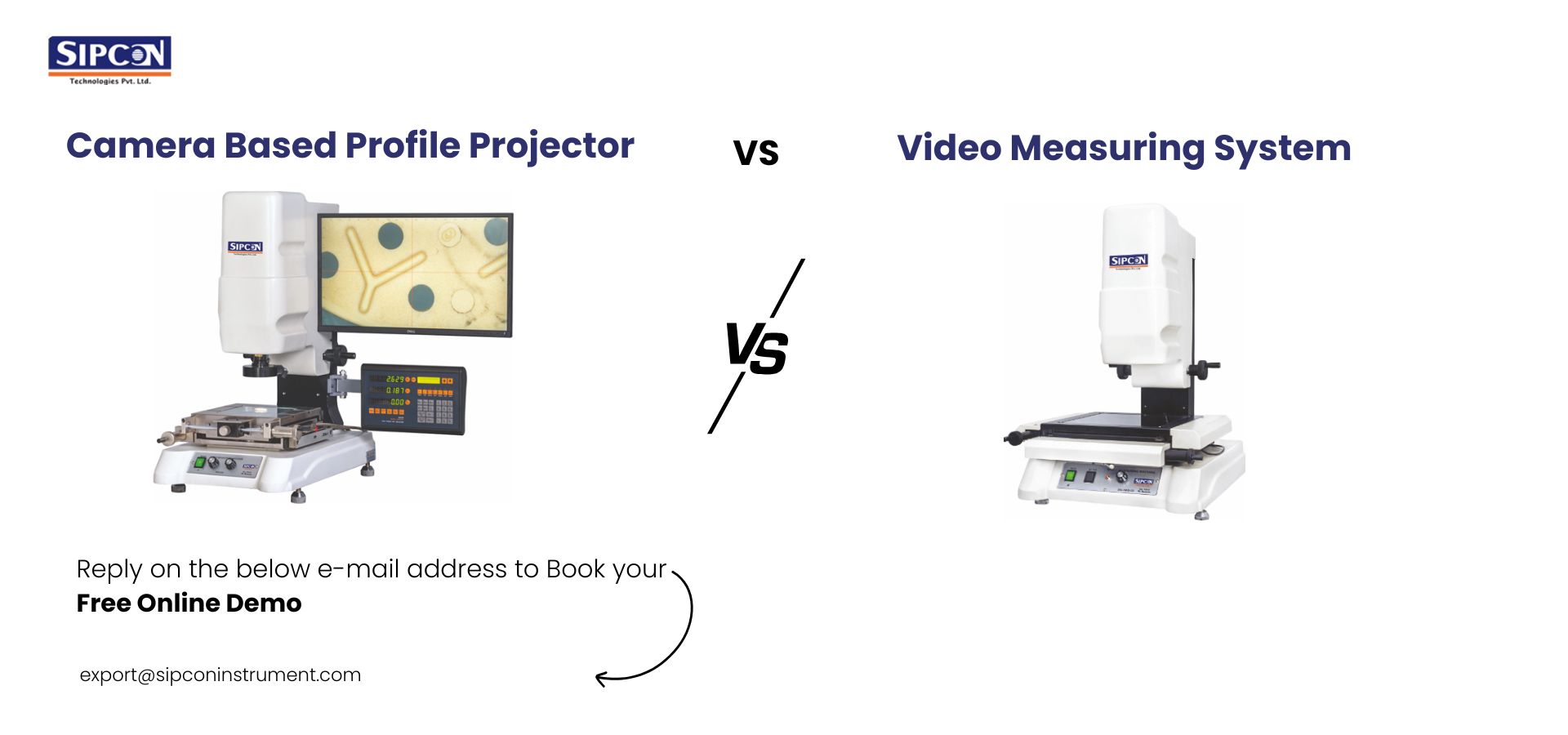
A camera-based profile projector is a device that projects a magnified image of a small part onto a screen for easy measurement. This precision measurement machine uses a strong light source to create a sharp silhouette of the object being inspected.
Its working principle is simple. High-quality lenses enlarge tiny parts so operators can clearly examine edges and contours of items like screws, gears, and plastic components. In many factories, the projected image is also compared with a pre-drawn map to check if the part matches the required design.
A camera-based profile projector is widely used in engineering toolrooms because it produces a clear and bright image for operators. It helps ensure that every component leaving the factory has the correct shape and fits perfectly into the final product.
What is a Video Measuring System?
A video measuring system is a high-tech tool that uses a digital camera to capture images of components and measure them with high mathematical accuracy. Unlike a camera-based profile projector, which relies on light and shadows, this system works like a smart digital camera connected to a powerful computer.
This video measurement machine runs on advanced software that automatically detects points and lines on a part. It captures an image and quickly performs the required calculations, allowing measurements to be completed accurately with minimal operator effort.
Key Differences Between a Video Profile Projector and a Video Measuring System
| Feature | Camera-Based Profile Projector | Video Measuring System |
|---|---|---|
| Technology | A camera-based profile projector uses optical projection to magnify and display the outline of a component on a screen for measurement. | A video measuring system uses digital cameras and imaging sensors to capture part images and measure them through computer software. |
| Accuracy | Provides reliable accuracy for routine inspection of standard parts. | Delivers very high precision with consistent results using digital image processing. |
| Automation | Mostly manual or semi-automatic, requiring the operator to position and move the part. | Fully automated with motorized stages and programmed measurement routines. |
| Software | Includes basic software designed for simple measurement tasks. | Uses advanced software capable of complex geometric calculations and automated analysis. |
| Best for | Best for inspecting simple parts with basic shapes and profiles. | Ideal for complex components with multiple holes, curves, and intricate features. |
Applications in Industry
- Automotive manufacturing: Sizes of fuel injectors, engine valves, and other critical parts are inspected using a precision video measurement machine.
- Electronics and PCB inspection: A camera-based profile projector helps companies check circuit board pins for bending or damage by clearly displaying tiny pin details.
- Aerospace components: Engineers use these systems to inspect turbine blades, where even the smallest measurement error can cause serious problems during flights.
- Medical devices: Manufacturers use these tools to inspect tiny needles and surgical instruments used in hospitals.
- Precision engineering: These systems help produce parts that require extremely accurate measurements to fit inside compact devices like smartphones and electronics.
Benefits of Optical Measurement Systems
- Non-contact measurement: The video measuring system provides non-contact measurement capabilities, which allow users to measure soft rubber or thin plastic parts without causing any deformation.
- High accuracy: The precision measurement machines deliver measurements that are more accurate than human ruler measurements, which results in fewer errors and significant reductions in material waste.
- Faster inspection: The inspection process becomes significantly quicker because the camera system can detect part edges within a time span of less than a second.
- Data recording: It allows you to record every single piece of data, which helps a company prove to its customers that its work is perfect.
- Improved quality control: Quality control is much improved when you use them because they do not get tired or bored like a human worker might and produce erroneous results.
Which One Should You Choose?
Budget: If you have a tight budget and only need to check simple shapes, a camera-based profile projector is a very reliable and cost-effective choice for your shop.
Required accuracy: For those who need the highest level of accuracy for very complex parts, spending more on a video measuring system is definitely the smarter long-term move.
Automation needs: Think about your automation needs because a camera-based profile projector is usually manual, while the other machine can work almost entirely on its own with software.
Production scale: The production scale matters a lot because a measuring system can handle high volumes much better than a projector that needs a human operator.
Complexity of parts: Consider the complexity of your parts, as a projector might struggle with tiny 3D details that a digital camera can see quite easily.
Conclusion
You need to choose between a camera-based profile projector and a video measuring system based on your inspection needs and the level of automation required for daily quality control.
Both systems offer distinct advantages, so many large manufacturing facilities use them for different inspection tasks. The right choice depends on balancing machine costs with the long-term savings gained from precise measurement results.
Call: – +1 (262) 391-4785
Mail: – us@sipconinstrument.com