

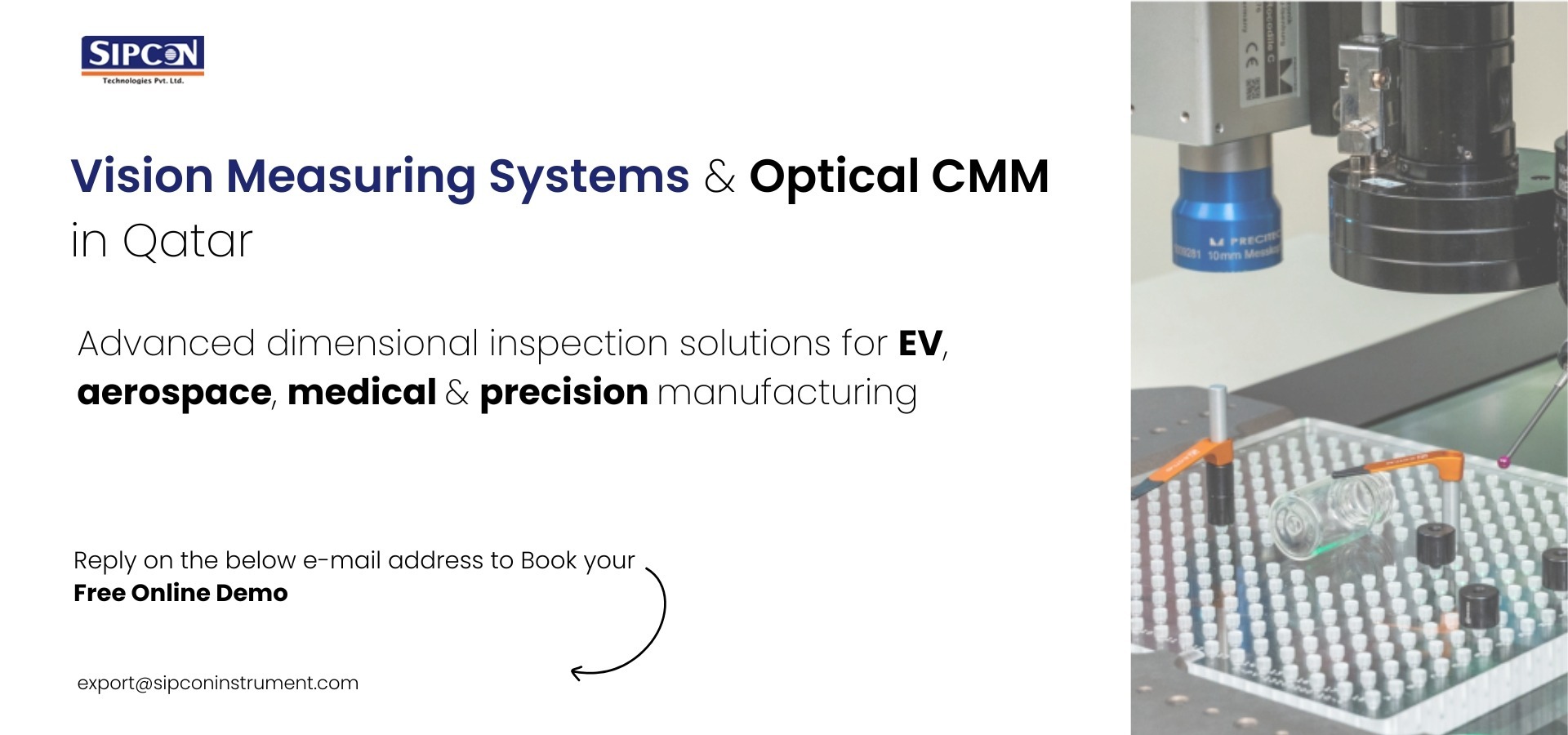
Vision Measuring Systems & Optical CMM for Qatar’s New EV, Aerospace and Medical Manufacturing Sector
Vision Measuring Systems & Optical CMM for Qatar’s New EV, Aerospace and Medical Manufacturing Sector
Qatar’s industrial landscape is entering an important phase. Under the Qatar National Manufacturing Strategy 2024-2030, the country is seeking to expand manufacturing capabilities, strengthen non-hydrocarbon exports and attract new industrial investment. The strategy targets a manufacturing value added of QAR 70.5 billion and annual industrial investment of QAR 2.75 billion by 2030.
For manufacturers establishing new production capacity, this creates an opportunity to build dimensional inspection and quality control into production from the beginning. Choosing experienced vision measurement systems manufacturers in Qatar and appropriate metrology equipment can help Qatar-based companies establish repeatable inspection processes for EV components, aerospace parts, medical products, electronics and precision engineering applications.
What Qatar’s National Manufacturing Strategy 2024-2030 Means for QC Equipment Buyers
Qatar is developing an increasingly diverse advanced-manufacturing ecosystem. Qatar Free Zones identifies automotive and transport equipment, aerospace and aviation, pharmaceuticals and life sciences, and industrial products among its permitted sector clusters. Its industrial infrastructure is also intended to support advanced manufacturing and technology-led businesses.
It is, therefore, not sufficient to think of metrology as a final investment for QC teams and equipment buyers.
A new manufacturing line can be designed around measurable tolerances, documented inspection routines and traceable quality procedures. Vision measuring machines, optical CMM systems, inspection magnifiers and material-analysis equipment can all become part of the original quality plan.
This is particularly relevant when Qatar-based manufacturers intend to serve demanding domestic, GCC or export customers.
Vision Measuring Systems for New EV-Component Production Lines
Electric vehicles bring together precision-machined parts, battery components, connectors, electronics, housings, seals and numerous small components that require dimensional consistency.
A FOV Video Measuring Machine / Vision Measuring System is a non-contact measurement system that is realised by optical imaging. Depending on the machine configuration and application, manufacturers can inspect dimensions such as lengths, diameters, hole positions, profiles and feature spacing without physically probing delicate surfaces.
For Qatar’s developing automotive and advanced-manufacturing environment, this can be useful for incoming inspection, first-article verification and routine production QC.
When comparing vision measurement systems manufacturers, buyers should look beyond magnification alone. Measuring range, repeatability, camera and optics quality, software capability, calibration support and compatibility with the required inspection workflow are equally important.
The ISO 10360 family offers acceptance and reverification methods for coordinate measuring systems in Qatar. The appropriate part of the standard depends on the measurement technology and system configuration, so buyers should confirm which ISO 10360 requirements apply to their equipment rather than treating the series as a single universal specification.
Optical CMM for Aerospace Additive-Manufacturing (3D-Printed Parts) QC
Qatar Free Zones is actively positioning the country for aerospace and aviation activities, supported by connectivity around Hamad International Airport and an aerospace-focused ecosystem.
As aerospace manufacturing technologies develop, dimensional verification becomes especially important for complex components, including parts produced through additive manufacturing.
A suitable precision feature can be inspected using an optical coordinate measuring machine without using a purely contact probing method. This can be valuable where components have small geometries, fine edges or surfaces for which non-contact inspection is preferable.
For additive-manufactured parts, inspection may include dimensional accuracy, feature location and comparison against defined engineering tolerances. Optical measurement is not required to be used as a substitute for all other inspection technologies but may be an essential component of a larger aerospace QC strategy.
Table Top Magnifiers and CBD Testing for Qatar’s Existing Plastics & Cable Extrusion Base
Advanced manufacturing is only one side of Qatar’s quality-control requirements. Plastics, polymers, cables and industrial materials remain relevant to construction, utilities, energy and infrastructure supply chains.
A Table top magnifier in Qatar provides a straightforward solution for visual inspection of small components, cable features, electronic assemblies and surface defects. IPC-A-610, the widely used acceptability standard for electronic assemblies, includes visual inspection criteria, while IPC documentation also addresses magnification used during inspection.
For cable and polymer manufacturers, material consistency is another concern. A Carbon black dispersion tester in Qatar comprising a CBD & Void Contamination Microscope is utilised to evaluate carbon-black dispersion and contamination characteristics of applicable polymer and cable-material samples.
Used alongside appropriate sample preparation and relevant material test procedures, this type of equipment helps manufacturers identify dispersion irregularities or voids that could affect material consistency.
Meeting QGOSM and GCC Conformity Requirements
Manufacturers operating in Qatar need to consider applicable national technical requirements as well as relevant GCC and international standards for their products.
Qatar’s standards infrastructure includes the Qatar General Organization for Standardization and Metrology (QGOSM), and the Qatar Quality Mark initiative has emphasized compliance with approved specifications and effective quality-control systems for national products.
For medical-device and medical-consumables manufacturers, ISO 13485:2016 establishes quality-management-system requirements specific to medical devices. ISO confirms that the standard remains current following its 2025 review.
Selecting measurement equipment should therefore begin with the product specification, applicable regulatory requirements and required measurement uncertainty-not simply a machine specification sheet.
Sipcon for Qatar Free Zones and Qatar Science & Technology Park Manufacturers
For manufacturers establishing or expanding quality laboratories in Qatar, Sipcon offers inspection and measurement solutions for different stages of production.
The FOV Video Measuring Machines / Vision Measuring Systems, Optical Coordinate Measuring Machines, TTM Table Top Magnifiers and CBD & Void Contamination Microscopes are all included in the portfolio.
Whether the requirement involves precision components, electronics, polymers, cables, medical products or emerging advanced-manufacturing applications, the objective is the same: establish dependable inspection capability before quality problems become embedded in production.
Explore Sipcon’s global Vision Measuring System, Optical CMM, and CBD product resources for equipment details and application options.
Request a Quote for Qatar through the contact form to discuss the measurement range, component type, inspection requirements and suitable QC configuration for your facility.
FAQs
Q.1. What is a vision measuring system used for?
Ans. A vision measuring system uses cameras, optics and measurement software to inspect suitable component dimensions and geometric features without conventional contact probing.
Q.2. How does a vision measuring system differ from an optical CMM?
Ans. The terminology can overlap between manufacturers. In general, optical CMM systems emphasize coordinate-based precision measurement, while vision measuring systems cover a broader range of image-based dimensional inspection applications. The exact capabilities depend on machine configuration.
Q.3. Why should new Qatar factories install metrology equipment early?
Ans. Integrating QC equipment while production processes are being established makes it easier to define inspection routines, measurement records and acceptance criteria around the manufacturing process rather than adding them after production has scaled.
Q.4. Which standards should Qatar manufacturers consider?
Ans. Requirements depend on the product and market. Relevant frameworks can include applicable parts of ISO 10360 in Qatar for coordinate measurement, ISO 13485 for medical-device quality management, IPC-A-610 for electronic-assembly acceptability, and applicable Qatari and GCC technical requirements.