Profile Projector Machine: Types, Applications (2D/3D), and Buying Guide from Leading Manufacturers
In today’s manufacturing industry, accuracy matters a lot. Even a small measurement mistake can affect the quality of the final product. That’s why industries like automotive, electronics, aerospace, rubber, and cable manufacturing use advanced inspection tools for checking dimensions and profiles carefully.
One of the most commonly used inspection systems is the profile projector machine. It helps manufacturers inspect small components, curves, edges, and shapes with better accuracy than manual methods. Over the years, these machines have become more advanced, especially with the introduction of the digital profile projector.
From checking tiny electronic parts to inspecting rubber seals and industrial cables, profile projectors are now an important part of quality control departments. Many companies also prefer trusted brands like Sipcon Instrument because they offer reliable measuring solutions for industrial use.
In this blog, we’ll understand how a profile projector works, its different types, applications, and what things you should check before buying one.
What is a Profile Projector Machine?
A profile projector machine is a measuring instrument used for inspecting the shape and dimensions of small industrial components. The machine enlarges the image of the object on a screen, so the operator can measure and inspect it properly.
It is also called an optical projector because it works using light and optical magnification. The projected image helps operators compare dimensions, curves, angles, and edges very accurately.
Earlier, profile projectors were mostly manual, but now industries are moving toward modern digital profile projector systems that come with software, digital displays, and automatic measurement features.
These machines are widely used where precision inspection is required but the component size is too small for normal measurement tools.
Working Principle of Optical Profile Projector
The working principle of an optical projector is actually quite simple.
The component is placed on the machine table between a light source and the projection lens. When light falls on the object, its enlarged shadow or profile gets projected onto a screen.
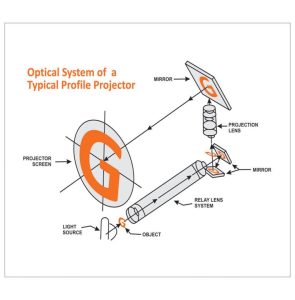
The operator then checks the projected image and measures dimensions like:-
- Diameter
- Length
- Radius
- Angles
- Curves
- Threads
Modern machines use digital cameras and software for more accurate readings. In advanced systems like 2D profile projector and 3D profile projector, measurements become faster and much more precise compared to older manual methods.

Types of Profile Projector Machines
Different industries need different inspection setups, so profile projectors are available in multiple types.
1. Horizontal Profile Projector
A horizontal profile projector is mostly used for long or cylindrical components. In this machine, the optical system is positioned horizontally.
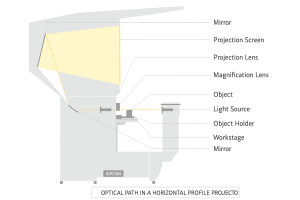
It works well for inspecting:-
- Shafts
- Screws
- Springs
- Threads
- Industrial cables
Many industries use a profile projector for cables because horizontal systems make cable alignment and inspection easier.
Applications:-
- Cable manufacturing
- Automotive shafts
- Thread inspection
- Spring analysis
- Medical components
2. Vertical Profile Projector
In a vertical system, the lens and light arrangement are positioned vertically. These machines are generally used for flat parts and compact components.
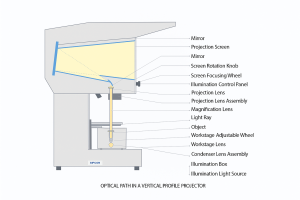
Applications:-
- PCB inspection
- Stamped metal parts
- Plastic components
- Electronic parts
Vertical projectors are commonly used in production lines where quick inspection is required.
3. Digital Profile Projector
A digital profile projector is basically the upgraded version of traditional profile projectors. These systems come with digital screens, software integration, image processing, and automatic measurements.
Instead of checking everything manually, operators can now measure components using software tools.
Some common features include:-
- Digital display
- Image capture
- CAD comparison
- Data saving
- Automatic edge detection
Industries now prefer digital systems because they save time and reduce human error.
4. 2D Profile Projector
A 2D profile projector is mainly used for measuring dimensions in two directions. It is suitable for regular quality inspection and production work.
Benefits:-
- Easy to use
- Faster inspection
- Accurate profile checking
- Cost-effective option
Most industries use 2D systems for day-to-day inspection activities.
5. 3D Profile Projector
A 3D profile projector is used when components have complex shapes or advanced geometries.
These machines use advanced imaging technology and software to inspect three-dimensional structures more accurately.
Applications:-
- Aerospace parts
- Precision molds
- Medical devices
- Automotive components
- High-precision engineering parts
For industries where even tiny dimensional variation matters, 3D inspection systems are becoming very important.
Core Components of a Profile Projector
Illumination System: Provides transmitted or reflected light for profile visibility.
Projection Lens: Magnifies the component image accurately.
Worktable: Holds and positions the component during inspection.
Digital Readout System: Displays measured dimensions and coordinates.
Image Processing Software: Used in modern digital profile projector systems for automated analysis and reporting.
Applications of Profile Projector Machines
The biggest advantage of a profile measuring machine is that it can be used across many industries.
Automotive Industry: Automotive manufacturers use these machines for checking gears, shafts, threads, brake parts, and engine components.
Electronics Industry: Profile projectors are widely used for checking PCBs, small connectors, and tiny electronic parts where proper measurement is really important.
Aerospace Industry: In aerospace work, accuracy matters a lot because even a small error can affect the final product. That’s why profile projectors are used for inspecting important components carefully.
Rubber Industry: Rubber manufacturers use profile projectors for checking seals, gaskets, O-rings, and other molded rubber parts during production.
Cable Manufacturing: These machines also help manufacturers check cable diameter, insulation thickness, and conductor alignment to maintain product quality.
Tool & Die Industry: Profile projectors are also useful for inspecting molds, dies, and cutting tools where maintaining the correct profile is very important.
Advantages of Using a Digital Profile Projector
Nowadays many industries are shifting toward digital inspection systems because they offer several practical advantages.
High Accuracy
A digital profile projector provides much better measurement accuracy compared to manual inspection methods.
Faster Inspection
Digital systems reduce inspection time because many measurements happen automatically.
Non-Contact Measurement
The machine checks components without touching them, which is useful for delicate or soft materials.
Better Reporting
Inspection data can be stored digitally, making quality records easier to maintain.
Easy Operation
Modern systems are user-friendly and operators can learn them faster.
Improved Quality Control
Consistent inspection helps industries reduce defects and maintain better product quality.
How to Choose the Right Profile Projector Machine
Before selecting a profile projector machine, it’s important to understand your inspection needs properly.
1. Understand Your Application
First check what kind of components you will inspect.
For example:
- A horizontal profile projector is better for long components and cables.
- A 2D profile projector works well for normal dimensional inspection.
- A 3D profile projector is suitable for complex parts.
2. Check Magnification Range
Different jobs need different magnification levels, so always check lens options before buying.
3. Measurement Accuracy
Accuracy is one of the most important factors. Choose a machine that gives stable and repeatable measurements.
4. Look for Digital Features
Modern digital profile projector systems come with useful features like:
- CAD comparison
- Data export
- Auto edge detection
- Statistical analysis
These features improve productivity and reduce manual work.
5. Software Compatibility
Good software makes operation easier and improves reporting quality.
6. Machine Size
Check whether the machine table and screen size are suitable for your components.
7. Choose a Trusted Manufacturer
Always buy from a reliable profile projector manufacturer that provides service support and calibration assistance.
Companies like Sipcon Instrument are known for offering precision measuring systems suitable for industrial applications. Good after-sales support also becomes important in the long run.
Importance of Choosing the Right Profile Projector Manufacturer
Buying the right machine is important, but choosing the right profile projector manufacturer is equally important.
A trusted manufacturer usually provides:-
- Better machine quality
- Calibration support
- Technical service
- Installation help
- Operator training
- Spare parts availability
Industries in the Middle East are also searching for a reliable profile projector manufacturer in Saudi Arabia because manufacturing and quality control requirements are increasing rapidly there.
Many companies prefer experienced brands like Sipcon Instrument because reliable service and accurate measurement systems help improve long-term production quality.
Why Industries Prefer Digital Profile Projectors Today
Manufacturing industries are becoming more automated, and inspection systems are also changing with time.
A digital profile projector helps industries:
- Improve inspection speed
- Reduce manual errors
- Maintain quality records
- Increase production efficiency
- Improve product consistency
That’s why many manufacturers now prefer to buy profile projector machine solutions with digital software and automation features instead of traditional manual systems.
Future of Profile Measuring Machines
The future of the profile measuring machine industry looks more digital and automated.
Modern systems are slowly moving toward:
- AI-based inspection
- Automated measurements
- Cloud-based reporting
- Smart quality control systems
- Real-time analysis
As industries demand higher precision and faster production, profile projectors will continue becoming smarter and more efficient.
FAQs
Q1) What is an optical projector?
Ans: An optical projector is a machine used for checking and measuring small parts by showing an enlarged image on a screen. It helps operators inspect components more clearly and easily.
Q2) What is the principle of optical profile projector?
Ans: It works using light and magnification. When light falls on the component, its enlarged shadow or profile appears on the screen, making measurement and inspection much easier.
Q3) What are the three types of projectors?
Ans: The three common types are:-
- Horizontal profile projector
- Vertical profile projector
- Digital profile projector
Industries also use advanced systems like 2D profile projector and 3D profile projector depending on application needs.
Q4) What is the cost of digital profile projector?
Ans: The cost of a digital profile projector depends on:-
- Machine size
- Accuracy level
- Software features
- Magnification range
- Automation options
- Brand and manufacturer
Basic machines are more affordable, while advanced 3D systems cost more because of additional technology and features.
The Growing Importance of Profile Projector Machines in Modern Quality Inspection
Today, many industries use a profile projector machine to improve inspection accuracy and maintain product quality. These machines help in checking automotive parts, rubber products, cables, and other precision components more easily and accurately.
Nowadays, companies are preferring digital profile projector systems because they make inspection faster and reporting simpler. If you plan to buy profile projector machine solutions, choosing a trusted manufacturer is important. Companies like Sipcon Instrument provide reliable measuring solutions along with good industrial support.